
Detroit’s Baba Charles Begins with Episode 0: What an Elder Changes
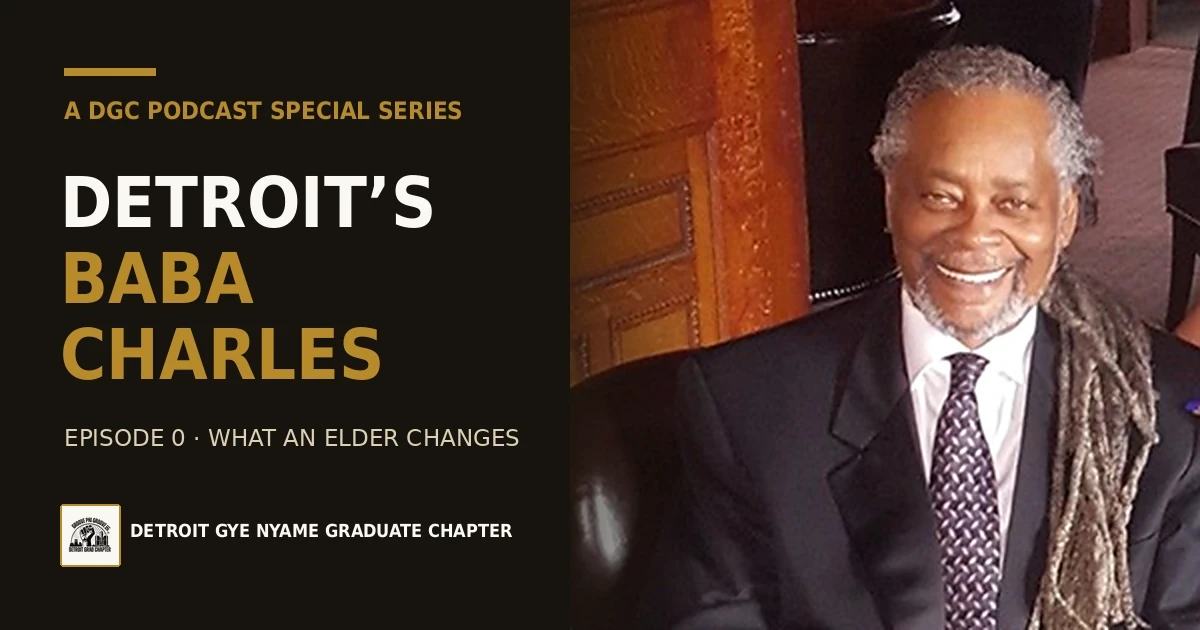
The Detroit Gye Nyame Graduate Chapter introduces Detroit’s Baba Charles, a podcast special series preserving the stories, lessons, and community legacy of journalist, educator, organizer, and Hush House co-founder Charles Simmons.
The series begins with Episode 0, “What an Elder Changes,” a short radio story about the meaning carried by the title “Baba,” the grandparents who raised Charles Simmons, and the moment an elder refused to let a school system decide the limits of his future.
“Baba” as a social contract
In Simmons’s telling, “Baba” is not simply a nickname or an honor a person claims. It describes a relationship: an elder’s responsibility to young people, the community’s recognition of service, and the obligation to pass knowledge forward.
That understanding gives the special series its frame. This is not only the story of one accomplished Detroit elder. It is also an inquiry into what elderhood requires and what communities preserve when they make room for living memory.
The intervention
As a teenager, Simmons was placed in a trade curriculum. When he asked to move into college preparation, a counselor refused. His grandmother went to the school, met with the superintendent, and changed the decision.
He does not remember the words spoken inside that room. He remembers the result: the opportunity to prepare for college and the life that became possible afterward. Episode 0 asks listeners to consider the distance between a title and an action—and what an elder changes by acting at the right moment.
A different measure of wealth
The episode opens and closes with Simmons describing himself as already rich. His measure includes family, knowledge, health, experience, relationships, and the ability to share those resources. It is a definition rooted less in possession than in what a person can carry forward for others.
Listen and read
Listen on the complete Episode 0 page for the interactive waveform, chapter markers, full show notes, and download.
Read the accessible transcript for an edited, machine-assisted text version of the program.
Production note: Baba Charles’s voice comes from oral-history and public-interview recordings. The connecting narration was produced from an editorial script using a synthetic male voice. Consult the audio before quoting.