There's a version of Wildemere Park's alleys and vacant lots that most people drive past without a second look — grass grown up around old foundations, an alley that's really just a shortcut for whoever already knows it's there. The Groove Cut starts from a different premise.
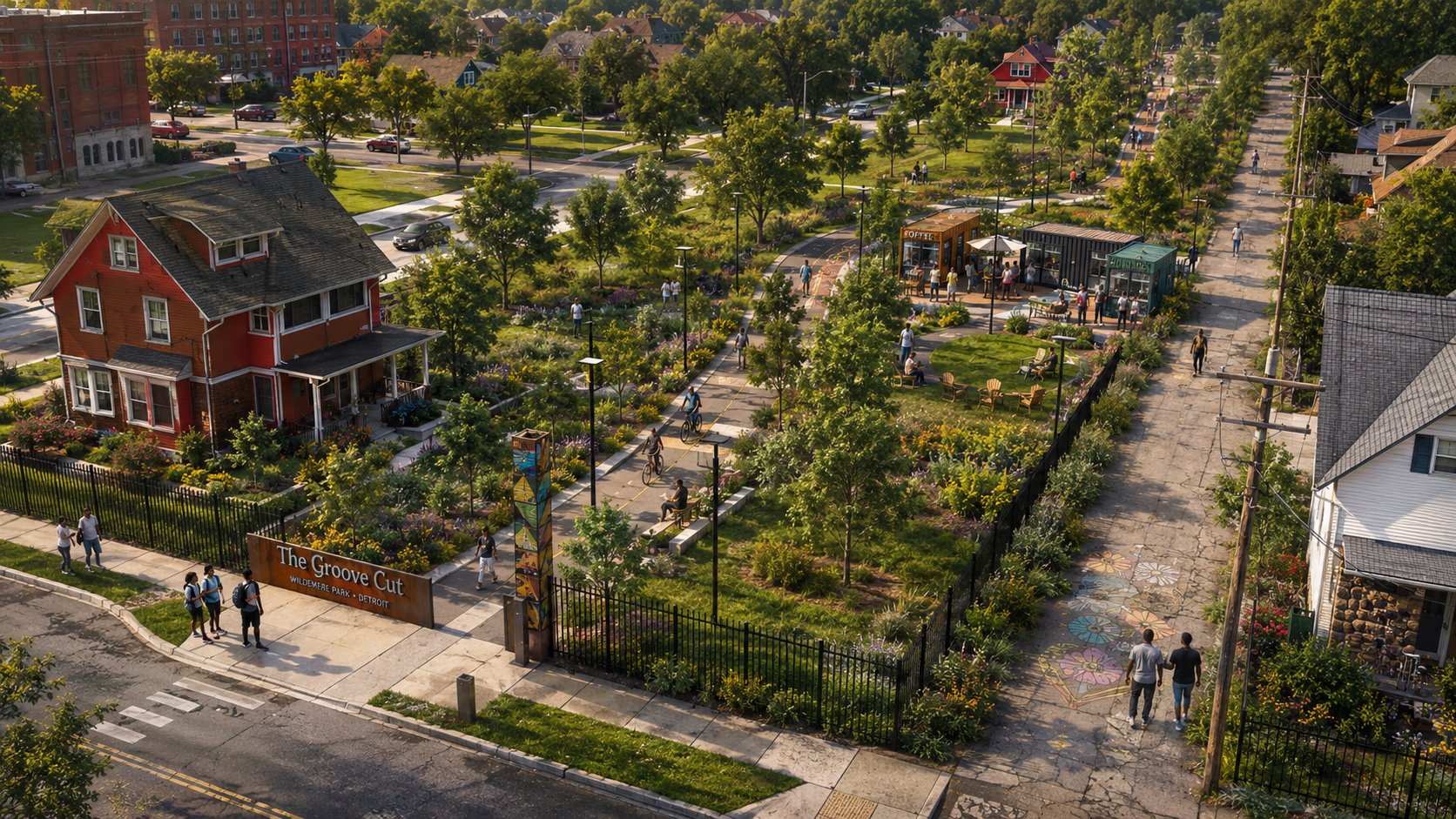
That same ground, stitched together block by block, is the beginning of the neighborhood's connective tissue rather than the evidence of its disinvestment. Where Detroit's Dequindre Cut turned an abandoned rail line into a corridor reconnecting downtown to the riverfront, the Groove Cut applies the same instinct at the scale of a residential neighborhood — turning alleys and side lots most people have written off into a walkable, plantable, sellable, livable spine running through Wildemere Park.
It starts small and specific: one alley running from Lothrop to Northwestern, four lots alongside it. But the ambition isn't a single beautified block — it's a network, alley by alley, lot cluster by lot cluster, that eventually gives Wildemere Park a green route residents can walk from one end of the neighborhood to the other, with places to sit, buy something from a neighbor's stall, and see the block cared for rather than abandoned. Because it grows out of the Groove Community Campus, it isn't a park built and left to fend for itself — it's tied from day one to the workforce training, entrepreneurship support, and wraparound services the campus already runs a few blocks away on Dexter.
The Groove Cut · Wildemere Park GreenwayThe Vision / Built Out
Artist's RenditionThe Groove Cut greenway · Lothrop to Northwestern · Detroit's West Side
Impact Statement
From a symbol of blight to infrastructure for opportunity
The Groove Cut exists to convert Wildemere Park's vacant land from a symbol of blight into infrastructure for opportunity — measured not just in square footage greened, but in small businesses launched from a converted lot, residents trained in the skills that build and maintain it, and a visible, walkable answer to the question of what comes after vacancy.
Every segment reclaimed is meant to do three things at once: give the neighborhood a safer, greener, more connected physical environment; give residents a low-barrier entry point into entrepreneurship, from a market stall to eventually a storefront; and give the campus's existing training programs a real, visible place to put their graduates to work. Success isn't just a prettier alley — it's fewer vacant parcels sitting idle, more residents with a credential or a small business tied to this ground, and a growing sense that Wildemere Park's next chapter is being written by the people who already live there.
Site Overview · Phase One
One alley, four lots
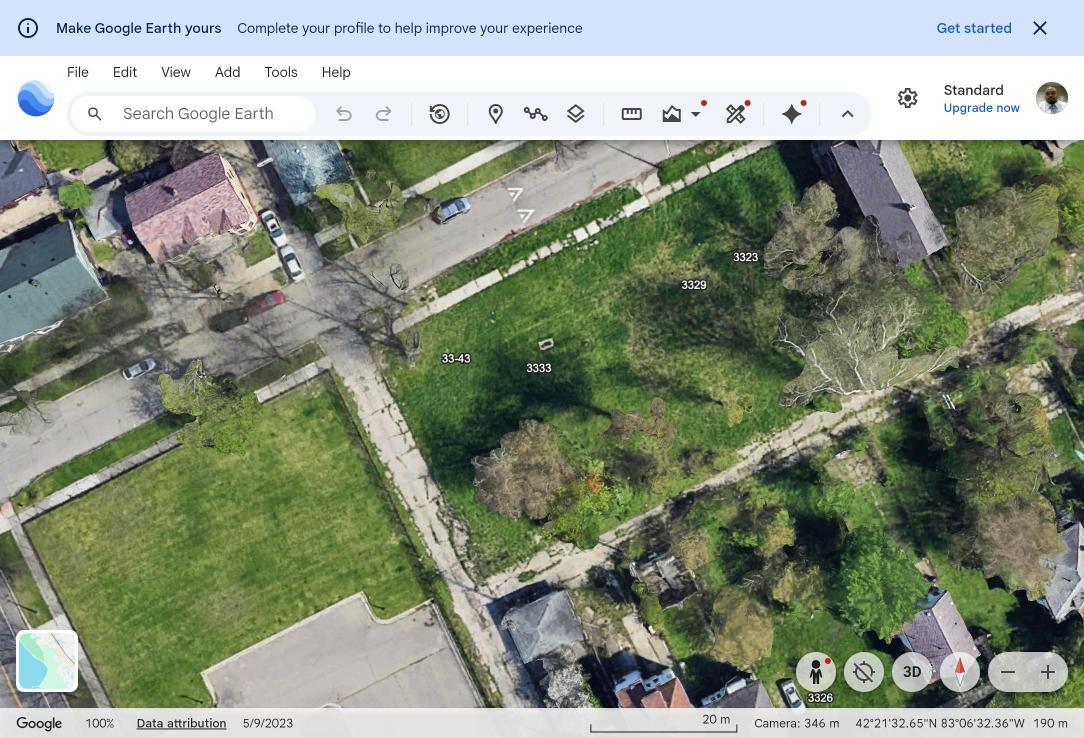
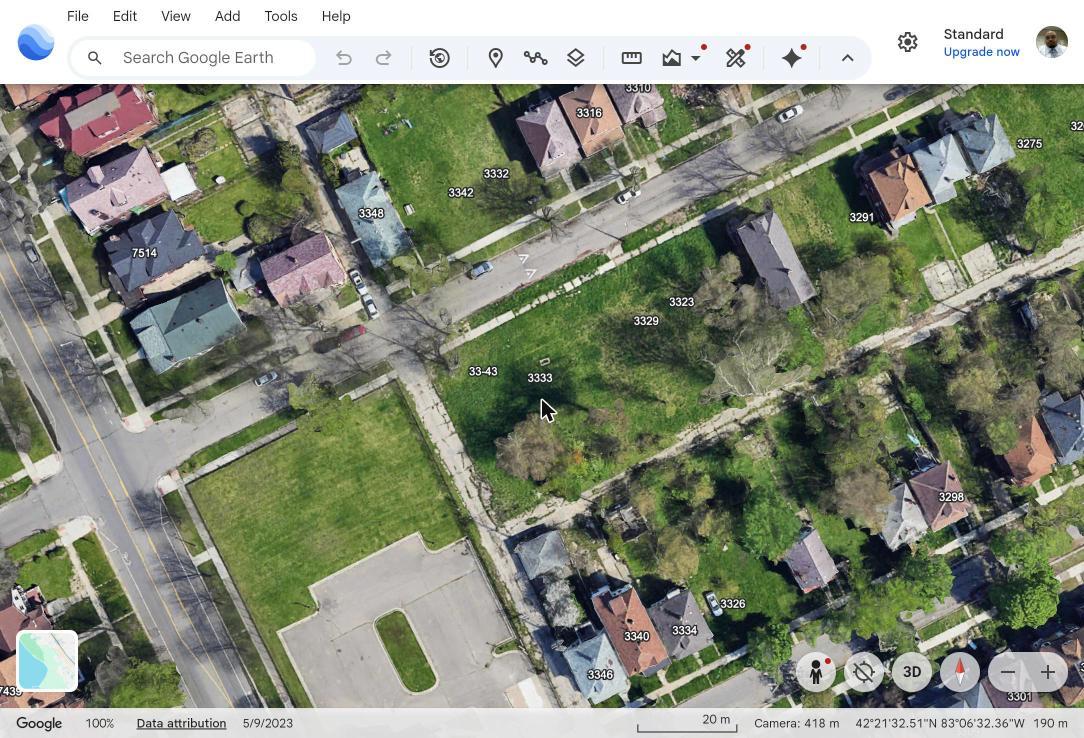
The pending Phase One footprint: the alley connecting Lothrop to Northwestern, and the four adjoining Northwestern lots — 3343, 3333, 3329, and 3323. Existing desire-path trails are already visible cutting through the grass, a strong signal of latent pedestrian demand for a formal path.
Close-up aerial view of the four Northwestern lots (3343, 3333, 3329, 3323) with the alley running behind them.Wider context view showing the Northwestern lots backing onto the alley, with the Lothrop-side block (including 3347 Lothrop) beyond.
Where It Can Go
Proof of concept, not the ceiling
Once the Lothrop-to-Northwestern stretch is built out — path, plantings, a small vendor node, maybe a gathering lawn — it becomes the thing people can see rather than just hear described. From there, the model is deliberately repeatable: identify the next cluster of alleys and vacant lots nearby, bring the same combination of physical greening and campus-connected programming, and let each completed segment make the case for the next one, both to funders and to neighbors deciding whether to get involved.
Over time, that repetition is what turns a single greenway into a network — a green grid threading through Wildemere Park rather than a single amenity in one corner of it. Northwestern High School's proximity to the first segment also opens a natural anchor point: a hub where the neighborhood-wide effort organizes itself, echoing how other Detroit revitalization efforts have anchored block-by-block work around a school. There's also room here for the initiative to eventually outgrow the campus that started it — a good outcome, if and when it happens, rather than something to guard against.
Reference Models
Proven in Detroit
Detroit, MI
The Dequindre Cut
A below-grade greenway built on a former Grand Trunk Western rail line, running roughly 1.35 miles and connecting Detroit's riverfront to Eastern Market — a paved multi-use path with murals, lighting, and the Dequindre Cut Freight Yard, a cluster of shipping-container vendor stalls alongside the trail.
The direct lesson for the Groove Cut: pairing a trail with a small, low-barrier commercial node is what turns a greenway from a place people pass through into a place people stop.
Detroit, MI
Life Remodeled
A Detroit nonprofit known for large-scale volunteer mobilizations — short, intensive build days — focused block by block around a Detroit high school, pairing physical cleanup and beautification with a wraparound services hub offering job training, mentorship, and neighborhood support.
The direct lesson for the Groove Cut: the physical build and the social service layer happen together, anchored around a school, rather than as two separate efforts on two separate timelines.
Initial Steps
The opening chapter
Right now, the story is still in its opening chapter: the application to purchase the Lothrop alley and the four Northwestern lots is in, and everything downstream depends on that land coming under the campus's control.
While that's pending, the groundwork worth laying is less about construction and more about proof — sketching the actual design concept for that first segment (the path, the vendor node, the gathering space) into something concrete enough to show a funder or the Land Bank, and naming what "success" looks like in terms the campus already measures: reduced blight, residents trained, small businesses seeded.
Once the parcels close, the first physical steps are deliberately modest — clearing and defining the alley path, stabilizing the lots, getting basic lighting and plantings in — sized to be achievable without waiting on the full vision to be funded before anything visible happens. In parallel, this is the moment to start the quieter work of neighborhood buy-in: talking to the people who live on Lothrop and Northwestern now, before volunteers show up with tools, so the first segment feels like something the block asked for rather than something that arrived.
Be Part of It
Help write Wildemere Park's next chapter
The Groove Cut grows out of the same campaign that's building the campus on Dexter Avenue. Supporting the campus supports the ground it stands on.